Showing posts with label education. Show all posts

Wednesday, March 12, 2008

Fun With Fungi for Teachers and Students.

What you need:
1. A sealable sandwich bag
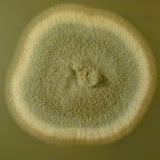
2. A piece of bread (I used some leftover porkchops, see photo on the right, covered with Pencillium sp.).
3. A paper towel
4. A little soil from outdoors or a potted plant


What you do (Part 1):
1. Place your bread in the bag. Dampen the paper towel and put it in the bag
with the bread and add a pinch of soil. The soil carries a few mold spores.
2. Let some air in the bag and zip it or tie it up so it's securely sealed. Label the
bag with the date and a name for your experiment, say, “Mold Test 1”.
3. Put the bags in a warm, dark place for about three days.
4. Look at the bread with a magnifying glass through the bag. If nothing has
happened after three days, wait three more.
5. Soon you’ll have a mold garden.

Very Important
THROW AWAY BAGS WITHOUT OPENING THEM WHEN FINISHED.
Breathing too much mold can make you sick. In dirt, mold is very spread out.

What’s happening?
Mold is not a kind of plant. Mold is not a kind of animal. Mold is a kind of fungus.
Fungi (FUN-jie) thrive by attaching themselves to a source of food. Famous
fungi include mushrooms, yeasts, mildews, and “athlete’s foot” fungus.
Mold is made up of millions of spores, or tiny microscopic seeds, all growing
together in a colony. Mold comes in a variety of furry, bright-colored blobseverything
from red to bright purple, depending on the type. The fuzzy-looking
spores weigh so little, tiny air currents can carry them through the air. When they
land someplace where the conditions are just right, they grow into new fungi.


Copyright 2001, Bill Nye and Nye Labs, LLC.All rights reserved.

Tuesday, February 26, 2008

A little About Me

I have worked in the field of indoor air quality since I graduated with my doctorate in 2002. But I started studying molds much earlier in my career as an undergraduate research student (1990). In all those years I have never lost my fascination with these remarkable creatures. That fascination and experience is what defines my goal as Director of Clean Air Labs.

As a laboratory director, I strive to provide inspectors and their clients with the best possible microbial detection technology available. In addition, I try to provide clients with the means wherewithal to use that technology. Because, in the microbial world, there are all kinds of werewolves, but no silver bullets. I view any technology, no matter how grand, as a tool, and treat it as such. No single technology is ever going to provide all the solutions. Microbes live together in complex and dynamic communities, regardless of habitat. Unlike asbestos or lead, microbial communities are subject to rapid change in relation to environmental condition. Inspectors need to be able to deal with the biological dynamics inherent in microbial communities in order to solve indoor air problems. Hence, an inspector needs many tools in the toolbox. My goal is to provide those tools along with the knowledge to answer the tough biological questions that are so often associated with problems found indoors.

A life goal I have is to educate. I am convinced that our children need to learn science starting in grade school; hence, I founded the IAQ Outreach Program with Clean Air Labs, where I and my staff educate elementary students concerning the importance of healthy indoor environments. A more advanced form of the program allows local high school classes to visit the lab on field trips to have hands-on experience with biotechnology and DNA assays for environmental microbiology.

Specialties:
Educator, DNA-based Mold Investigations, Inventor, Consultant, Product Evaluator, Seminar Speaker, Research Scientist, Fluorescent Microscopy, Microbial Detection Technology